A custom water loop turns a PC into a quiet, cool-running showcase, but the parts list gets long fast. Fittings, rigid tubing, a radiator, reservoir brackets, and rotary adapters each pull their weight, and skipping the wrong one wrecks an otherwise tidy build. I put together a shortlist of six components that show up in serious loops and explain what each actually does, so the next parts order has fewer surprises.
How The Shortlist Stacks Up

PrimoChill RevolverSX Rigid Fitting 6-Pack (Copper)

Corsair Hydro X 90° Rotary Adapter Twin Pack

CORSAIR Hydro X XR5 360mm Radiator (Black)
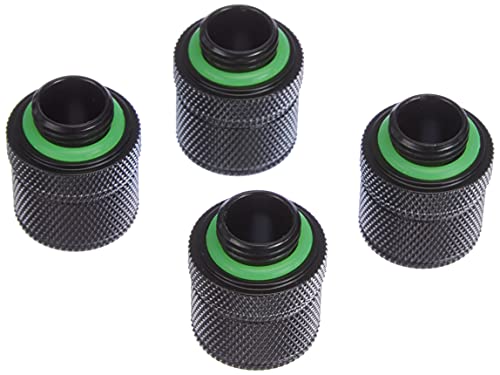
Corsair Hydro X XF Compression Fittings Four Pack

CORSAIR Hydro X XT Hardline 14mm Tubing

EKWB EK-Loop Angled Bracket 120mm
More Details On Our Top Picks
Rigid tube fittings do the quiet work of holding a custom loop together, and PrimoChill’s RevolverSX line leans hard into the showpiece side of that job. The six-pack gives a loop builder enough fittings for a CPU plus GPU run with a couple in reserve, and the copper finish reads like jewelry against a tempered-glass panel.
Where the earlier rotary adapter in this list solves routing problems, the RevolverSX focuses on visual impact. G 1/4 threading (the standard pipe thread used across nearly every water cooling component) keeps compatibility broad, and the brass core gives the fittings the heft that cheaper zinc alternatives lack.
Bright Spots
- Copper powder-coated finish stays color-consistent across multiple fittings, which matters when six caps sit in a row.
- Solid brass core plated for corrosion resistance, so coolant chemistry stays stable over years of use.
- G 1/4 thread standard fits every major water block, pump, and reservoir in this list.
- A 6-pack lowers the per-fitting cost compared to buying singles, useful for dual-radiator loops.
Trade Offs
- Rigid fittings demand precise tube measurement and bending, which is a steeper learning curve than the compression option reviewed later.
- The copper finish can patina over time if coolant additives aren’t refreshed, depending on the loop’s fluid.
Who It Suits Best
Builders with a glass-panel case who want visible fittings to match a copper-themed coolant and have measured their runs to the millimeter.
Consider Something Else When
Beginners who haven’t bent acrylic yet should look at the Corsair Hydro X XF Compression Fittings for a more forgiving first build.
Hardline tubing looks clean in renders, but real cases throw awkward angles at builders constantly. The Corsair Hydro X 90° Rotary Adapter solves that problem by letting a tube rotate after it’s been seated, so the bend direction can be tweaked without re-doing the entire run.
Unlike the rigid PrimoChill fittings above, these adapters twist freely, which makes them a pressure relief valve during final assembly. The black finish matches the rest of the Hydro X Series parts, and the sealed rotation mechanism keeps coolant where it belongs.
Practical Advantages
- Post-install rotation corrects slight misalignments without disassembling the run.
- Machined brass body with a sealed mechanism for leak-free pivoting.
- Standard G 1/4 threads thread into any Hydro X block or pump top.
- A twin pack covers a CPU plus GPU loop where both need angled exits.
Things To Consider
- Rotary joints add a small amount of restriction to flow compared to a solid 90° fitting, depending on pump head pressure.
- The black finish only blends with dark-themed builds, which limits color-matching options.
Feature Snapshot
Made For
Builders in compact cases where rigid 90° bends won’t fit and who need a second chance at alignment after seating the tube.
Skip It When
Anyone running soft tubing should choose the Corsair Hydro X XF Compression Fittings instead, since soft tube doesn’t need rotational adjustment.
A radiator is where custom loops earn their keep, dumping CPU and GPU heat into a column of airflow. The CORSAIR Hydro X XR5 360mm is built for that job, with room for three 120mm fans on each side and a copper core that moves heat quickly. In a full-tower case with a 360mm mount, it disappears into the chassis and does quiet, heavy lifting.
Compared to the PrimoChill fittings and rotary adapter already covered, this is the heat-exchange engine. The 30mm thickness gives it thermal mass for sustained loads, which matters when a gaming session turns into a long streaming run.
Strong Points
- Triple 120mm fan support on both sides pulls serious airflow through the fin stack.
- Copper core and brass tubes move heat efficiently to the coolant stream.
- 30mm radiator depth outperforms slimmer 25mm units in extended thermal testing scenarios.
- Matte black housing blends with most chassis without flashy branding.
Room For Improvement
- 30mm thickness won’t fit in cases designed for slim 25mm radiators, so case clearance should be confirmed first.
- Triple-fan radiators demand a case with adequate top or front 360mm mounting room, which rules out some mid-towers.
Best Suited To
Builders running high-TDP CPUs and overclocked GPUs who have a full-tower or 360mm-capable mid-tower case ready for the install.
Not Your Match When
Owners of small-form-factor cases should look at the EKWB EK-Loop Angled Bracket paired with a slimmer radiator, since 30mm depth won’t fit.
Compression fittings are the friendlier cousin of rigid tube fittings. Instead of gluing or forcing tube into place, a compression ring tightens down to seal 10/13mm tubing (3/8″ inner diameter, 1/2″ outer) without precision bending. Corsair’s XF four-pack gives a small loop enough fittings to start, with room to grow.
Where the PrimoChill rigid set above rewards the patient builder, the XF compression set forgives the first-timer. Tighten by hand, no heat gun, no jigs, and the loop holds.
A Few Strong Suits
- Compression seal works without heat-bending acrylic, which lowers the barrier for newcomers.
- 10/13mm sizing matches CORSAIR’s own 14mm hardline OD options after the right adapter sleeve is used.
- Brass body with a black finish coordinates with the Hydro X radiator and adapter above.
- Four-pack handles a small CPU-only loop with a spare in case of a stripped thread.
Points To Note
- Compression fittings need periodic re-tightening after the first few thermal cycles, depending on how the loop is sealed.
- Four-pack may run short on larger dual-radiator loops with both a CPU and GPU water block.
Quick Facts
Who Should Grab It
First-time custom loop builders who want a forgiving seal and aren’t ready to invest in a heat gun and bending kit.
Look Elsewhere When
Veteran builders chasing a rigid acrylic aesthetic should choose the PrimoChill RevolverSX fittings for the visual match.
The tubing itself is what people stare at through a glass panel, so it has to look good. CORSAIR’s Hydro X XT 14mm hardline uses PMMA (polymethyl methacrylate, the same family as acrylic), which keeps the coolant visible and resists warping at higher temperatures. For builders chasing that “coolant on display” look, this is the medium that carries the show.
Compared to the rotary adapter reviewed earlier, this is the raw material the adapter adjusts. Straight runs are crisp, bends hold their shape, and the clear wall lets colored coolant pop.
A Favorable Mix
- Crystal-clear PMMA wall keeps colored coolant fully visible through the panel.
- 14mm outer diameter pairs with the Hydro X compression fittings covered above.
- Resists warping under high pressure and elevated coolant temperatures, which extends loop life.
- Straight-line stock gives predictable bends with a standard heat gun setup.
Softer Spots
- PMMA tubing can crack if bent too sharply without annealing (gentle pre-heating), depending on the bender used.
- Clear tubing shows every air bubble, so a bleed port or reservoir top is a near-necessity.
Feature Rundown
Whose Shelf It Belongs On
Builders planning a showcase build with colored coolant and a glass panel who don’t mind spending time on precise bends.
A Better Fit Elsewhere
Someone who wants lower maintenance should skip this in favor of soft tubing and the Corsair Hydro X XF Compression Fittings, since soft tube forgives more setup mistakes.
EK’s FLT series reservoirs are slim and pancake-shaped, which is great for compact cases but awkward to mount. The EK-Loop Angled Bracket solves that by adapting FLT reservoirs to standard 120mm fan mounting holes, opening up install options that the reservoirs aren’t designed for out of the box.
Where the CORSAIR radiator above handles heat exchange and the fittings handle tubing, this bracket handles layout. Builders running FLT reservoirs in tight spaces will lean on it heavily.
Well-Handled Touches
- Mounts an FLT reservoir to any 120mm fan hole pattern, which is everywhere in modern cases.
- Compatible with both the long and short sides of FLT reservoirs for flexible orientation.
- Steel construction keeps the reservoir firmly seated under pump vibration.
- Removes the need for custom drilling or zip-tie mounting workarounds.
Potential Drawbacks
- Only fits EK FLT-style reservoirs, so non-EK reservoirs won’t work with this bracket.
- Steel material can clash with copper or brass fitting finishes if both are visible in the build.
The Right Fit
Anyone running EK FLT reservoirs in a case with 120mm fan mounts but limited reservoir-specific mounting spots.
Swap It Out When
Builders using a traditional tube reservoir should choose a standard reservoir mount instead, since FLT-specific brackets won’t apply.
What Actually Matters When Picking Custom Loop Parts
A custom loop lives or dies on compatibility, so the first thing to verify is thread standard. Every fitting, block, and reservoir in this list uses G 1/4 BSPP (a British Standard Pipe Parallel thread measured at 1/4 inch), which means parts from different brands generally thread together cleanly. Mixing and matching brands is fine; mixing thread standards is not.
Tube diameter comes next. CORSAIR’s Hydro X line uses 14mm hardline OD (outer diameter) and 10mm ID (inner diameter) as its standard, and the compression fittings in this list are sized for those measurements. Picking tubing and fittings that don’t match leaves builders with leaks or no seal at all.
Radiator sizing matters more than people expect. A 360mm radiator like the XR5 needs a case with at least 360mm of clearance at the mount point, plus room for 30mm of radiator depth. Sliding a 30mm radiator into a 25mm-optimized case won’t work, and the gap shows up at the final fitment check.
Material choice rounds out the practical decisions. Copper cores move heat faster than aluminum but cost more, and brass fittings resist corrosion better than plated zinc. For a loop meant to last several years, the small upfront premium on copper and brass pays off in stability and fewer discolored coolants over time.
Key Considerations Across These Picks
Pitfalls Shoppers Hit
Mixing thread standards is the most common first-time mistake, and it usually surfaces during the leak test. Confirming every fitting, block, and pump uses G 1/4 BSPP before any assembly starts saves hours of teardown. Buying tubing without confirming outer diameter is a close second, since 12mm and 14mm hardline look almost identical but won’t seal in the wrong compression ring.
What The Higher Tier Buys
Premium fittings and radiators carry thicker brass bodies, denser fin stacks, and tighter machining tolerances. The PrimoChill RevolverSX and the XR5 radiator cost more than generic alternatives, but the difference shows up in long-term loop stability and quieter operation. For a loop that runs daily for years, that premium tends to earn itself back in fewer rebuilds.
Frequently Asked Questions
What is G 1/4 BSPP and why does it matter?
It’s a thread standard (1/4 inch, British Standard Pipe Parallel) used across nearly every water cooling component. It lets parts from different brands thread together without adapters.
Can I mix brands in one custom loop?
Yes, as long as everything uses the same G 1/4 thread and matching tube sizing. The CORSAIR Hydro X parts in this list all work with EKWB reservoirs like the FLT series.
Do I need rigid or soft tubing?
Rigid acrylic like the CORSAIR XT hardline looks cleaner and lasts longer, but soft tubing is more forgiving for beginners and easier to service later.
How big should my radiator be?
For most gaming builds with a single overclocked CPU and GPU, a 360mm radiator is the sweet spot. Bigger loops running dual GPUs benefit from 480mm or two separate radiators.
How often should I refresh the coolant?
Most modern coolants last 12 to 24 months before color fades or conductivity rises, depending on the loop’s metal mix and operating temperature.
Wrap Up
A custom loop rewards builders who plan the parts list before buying anything, since compatibility errors are the real source of leaks and frustration. The six components above cover most of what a serious build needs, from rigid fittings to radiator mounts. Pick what fits the case and skill level first, then chase the aesthetic details once the foundation is solid.