A full tower used to be the only way to get a real gaming setup. That era is over. Today’s mini PCs pair modern Ryzen and Intel Core Ultra processors with serious integrated graphics, enough RAM for modern titles, and storage that swallows your whole library without blinking.
I pulled together six solid picks for shoppers who’d rather game on the desk than under it. Every option here balances size, thermals, and real-world frame rates, so the choice comes down to your priorities: AI horsepower, raw gaming frames, expandability, or a desk footprint so small it disappears.
The Essentials At A Glance

GMKtec Gaming Mini PC AMD Ryzen 7 H 255 32GB DDR5 1TB SSD
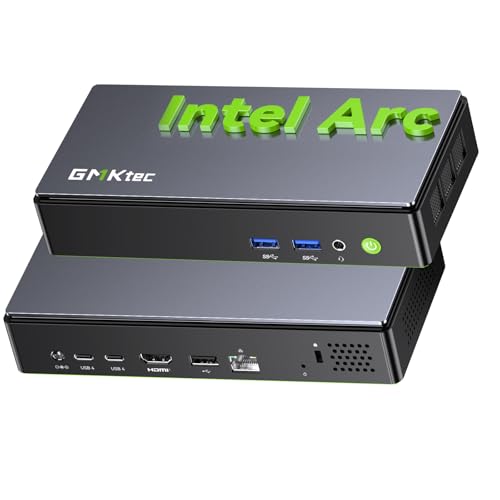
GMKtec K13 Mini PC Intel Ultra 7 256V LPDDR5 8533 MT/s

MTG Khuno Gaming Tower PC i7-8 16GB RAM 2TB NVMe, 2TB HDD
GMKtec K11 AMD Ryzen 9 8945HS 32GB DDR5 2TB PCIe 4.0 SSD

GMKtec K8 Plus Gaming Mini PC AMD Ryzen 7 8845HS 32GB DDR5

GMKtec M8 Mini PC Ryzen 5 PRO 6650H 16GB LPDDR5 1TB SSD
More On The Choices That Made The List
The Ryzen 7 H 255 chip at the heart of this GMKtec is an upgraded take on the older 8745HS, with 8 cores and 16 threads running up to 4.9 GHz. That kind of throughput handles modern esports titles at 1080p without dipping, and the bundled Radeon 780M graphics (integrated but surprisingly capable) make it a legitimate gaming entry point rather than a compromise box. For most living rooms and bedrooms, the size alone is the win: it slips behind a monitor, disappears under a TV stand, and barely makes a sound.
Owners commonly report solid thermals under sustained load, though it does warm up during longer sessions. The 32GB of DDR5 RAM keeps background apps and browser tabs from stealing frames mid-match, which matters more in real play than spec sheets suggest. Compared to the bigger MTG Khuno tower ahead, this one trades raw storage capacity for a footprint that fits anywhere.
Points In Its Favor
- Fast 8-core CPU handles modern esports and indie titles at smooth frame rates.
- Radeon 780M integrated graphics punch well above their weight class for 1080p gaming.
- 32GB of DDR5 means multitasking without dropping frames in-game.
- 1TB SSD loads large modern titles in seconds rather than minutes.
- Tiny chassis frees up desk space and travels easily for LAN parties.
Worth Noting
- Integrated graphics cap out at lower fidelity on demanding AAA releases.
- Compact cases can run warm during extended sessions, so airflow around the unit matters.
Who It Suits Best
Mainstream 1080p gamers who want a tidy desk and don’t need to push every setting to maximum.
Where Another Pick Suits Better
Shopers chasing massive storage for huge game libraries will find the MTG Khuno Gaming Tower PC a more natural fit.
Intel’s Core Ultra 7 256V is built on the TSMC N3B process, and that newer fabrication gives the K13 an NPU (a dedicated chip for AI tasks) plus a strong integrated GPU on the same die. The split matters: an NPU handles background AI features without dragging down gaming frame rates, so Windows effects, voice processing, and on-device assistants don’t compete for CPU cycles. The base clock of 2.2 GHz climbs to 4.8 GHz when a single core needs to sprint, which keeps single-threaded game engines happy.
SK Hynix LPDDR5 at 8533 MT/s feeds the chip with absurdly fast memory bandwidth. You feel this in texture-heavy games and any workflow that streams large files. Compared to the AMD-based GMKtec K11 reviewed later, this Intel variant leans harder into AI acceleration, while the K11 leans into raw multi-core clock speed. For the right shopper, that distinction is everything.
Standout Benefits
- 115 total TOPS of AI throughput (47 from the NPU plus 64 from the GPU) handles modern on-device AI features.
- 8533 MT/s memory bandwidth feeds the integrated GPU well, lifting frame rates in many titles.
- 4.8 GHz single-core boost keeps single-threaded game logic snappy.
- Compact chassis fits anywhere a router or game console would.
Honest Caveats
- AI-forward silicon shines most when the software you run actually uses the NPU.
- LPDDR5 is soldered, so memory upgrades later are not on the table.
Quick Technical Notes
Made For
Creators and AI-curious gamers who want a future-ready chip that handles modern features without a dedicated GPU.
Consider Something Else When
Those chasing pure 1080p gaming value should look at the GMKtec Gaming Mini PC AMD Ryzen 7 H 255.
The MTG Khuno is the only traditional tower on this list, and that brings obvious perks: real storage, real cooling, and a familiar full-size chassis. The 8th-gen Intel Core i7 with quad-core architecture and Turbo Boost handles most modern titles when paired with a discrete GPU, though on its own it sits a generation behind newer silicon. The big selling point is storage: 2TB NVMe for the boot drive plus a 2TB HDD for everything else means you install what you want, when you want.
Pre-installed Windows 11 Pro means setup is plug-and-go. Tower cases are also quieter per unit of performance because fans can move more air at lower RPM. The honest read is that this trades the absolute newest chip for capacity and upgrade room, which fits a specific kind of shopper.
Positive Points
- 4TB combined storage holds enormous game libraries without curation.
- Tower chassis offers room for future GPU and storage upgrades.
- Windows 11 Pro pre-installed saves an afternoon of setup.
- Bigger case means quieter fans under sustained load.
- Quad-core i7 still handles most esports and indie titles at decent settings.
Some Limits To Know
- 8th-gen Intel chip lags current-gen silicon in single-threaded game performance.
- No dedicated GPU included, so you’ll likely add one for serious AAA gaming.
- Tower footprint demands a proper desk or floor spot.
Best Suited To
Gamers who hoard libraries, plan to upgrade over time, and prefer a classic desktop form factor.
Skip It When
Anyone wanting a small, quiet, all-in-one box should reach for the GMKtec M8 Mini PC instead.
The Ryzen 9 8945HS pushes to 5.4 GHz on boost, with 8 cores and 16 threads tuned for heavy multitasking. At 35W TDP it sips power under light loads, and it can scale up to 70W when a game demands everything. That headroom translates to smoother frame rates in CPU-bound titles, and the dual-channel DDR5 layout doubles memory bandwidth over single-channel setups, which lifts integrated GPU performance noticeably. The 2TB PCIe 4.0 SSD reads large game files fast and keeps load screens brief.
This is the strongest CPU in this roundup, and it shows in benchmarks where single-thread speed matters. For shoppers who stream, record, and game simultaneously, the extra cores earn their keep. Against the K8 Plus ahead, this K11 gives up the dedicated NPU in favor of raw clock speed and a bigger SSD, which suits different workflows.
A Strong Showing
- 5.4 GHz boost clock is the highest in this roundup, lifting single-threaded game performance.
- Dual-channel DDR5 doubles memory bandwidth for integrated graphics.
- 2TB PCIe 4.0 SSD means quick boots and shorter load screens.
- 35W to 70W TDP scaling balances quiet operation with burst performance.
Trade-Offs To Consider
- Lacks the dedicated NPU found in the 8845HS-equipped K8 Plus.
- Smaller mini-PC cases can throttle under very long all-core loads.
Feature Snapshot
The Right Fit
Streamers and multitaskers who run background tasks while gaming and want top single-core speed.
A Better Fit Elsewhere
Shoppers prioritizing on-device AI acceleration will find more value in the GMKtec K8 Plus Gaming Mini PC.
The 8845HS inside the K8 Plus is the standout difference from the older 8745HS: it adds a dedicated NPU for AI work. That dedicated silicon handles Windows Studio Effects, background noise suppression, and on-device AI features without touching the CPU or GPU. The 8-core chip boosts to 5.1 GHz with a 16MB L3 cache, sitting between the 8945HS and the 8745HS in raw speed. Owners get a balanced machine that plays well in modern games while staying current with AI workflows.
The 35W to 54W TDP range keeps power draw sensible without throttling hard in compact cases. Compared to the K11 ahead, this one trades a bit of single-core speed and storage size for the NPU and a slightly lower price. For shoppers running streaming or AI-enhanced apps, the trade feels right.
Real Benefits
- Integrated NPU offloads AI tasks from CPU and GPU, preserving game performance.
- 5.1 GHz boost and 16MB L3 cache keep single-threaded games responsive.
- 32GB of dual-channel DDR5 handles heavy multitasking during streams or recording.
- Compact chassis is friendly to small desks and clean setups.
- 35W to 54W TDP keeps thermals manageable in tight spaces.
Possible Compromises
- 512GB SSD fills quickly with modern AAA installs at 100GB+ each.
- Lacks the higher boost ceiling of the Ryzen 9 8945HS in the K11.
Who Should Grab It
Streamers and remote workers who want AI features handled locally without slowing down gameplay.
Swap It Out When
Buyers chasing maximum clock speed and storage should consider the GMKtec K11.
The M8 stands out for its I/O, not its chip. Triple 8K display support through HDMI 2.1, DisplayPort 2.1, and USB-C 4.0 means this little box drives a serious productivity setup without breaking a sweat. The Ryzen 5 PRO 6650H hits 4.5 GHz on turbo with 6 cores and 12 threads, paired with Radeon 660M graphics that handle light gaming and creative work fine. The 6400 MT/s LPDDR5 and Oculink port (for connecting an external GPU enclosure) give this box a future upgrade path that most mini PCs skip.
The dual 2.5G NIC setup is unusual at this size, useful for networking enthusiasts and homelab tinkerers. The metal case also handles heat dissipation better than typical plastic enclosures. Compared to the Ryzen 7-powered GMKtec Gaming Mini PC earlier, the M8 trades raw CPU muscle for connectivity and expandability, which fits a different shopper entirely.
Everyday Wins
- Triple 8K display support drives serious multi-monitor productivity setups.
- Oculink port enables external GPU enclosures for graphics upgrades later.
- Dual 2.5G NICs suit networking-heavy users and homelab tinkering.
- Metal chassis helps dissipate heat during sustained workloads.
- USB-C 4.0 and HDMI 2.1 cover modern and legacy display needs.
Details To Watch
- Ryzen 5 chip lags Ryzen 7 and Ryzen 9 options for gaming frame rates.
- External GPU via Oculink adds cost and a desk footprint if you upgrade later.
Built With In Mind
Productivity-focused users who want multi-display capability and external GPU headroom in a tiny box.
Another Choice May Suit
Gamers chasing pure frame rate will find the GMKtec K11 AMD Ryzen 9 8945HS a stronger primary pick.
What To Weigh Before Picking A Gaming Desktop Bundle
The right match depends on what you actually play and where the box will live. Most modern integrated graphics handle esports and indie titles at 1080p, but pushing demanding AAA games at high settings usually means a discrete GPU, which none of these include.
CPU matters more than people think, especially the single-core boost clock. Many game engines lean on one fast core for logic, while multi-threaded chips help when you stream or record on the same machine. The Ryzen 9 8945HS in the K11 hits the highest boost in this group, which matters for CPU-bound titles.
RAM configuration affects integrated graphics performance a lot. Dual-channel DDR5 effectively doubles memory bandwidth over single-channel setups, which lifts frame rates in iGPU-heavy systems. The K8 Plus and K11 both use dual-channel layouts, while soldered LPDDR5 in the K13 limits upgrade room but runs fast out of the box.
Storage choices split by lifestyle. Tower buyers get room for multiple drives and easy future upgrades. Mini PC shoppers should expect one or two SSD slots, which means planning library size before buying. The MTG Khuno’s 4TB combined storage is the easy choice for hoarder-style gamers.
I/O and connectivity vary widely. The M8’s triple 8K display support, Oculink, and dual 2.5G NICs serve productivity users more than gamers, but they’re useful when a desk doubles for work and play. Compact form factors also benefit from solid cooling design, since smaller cases throttle sooner under sustained load.
Key Considerations Across These Picks
Pitfalls Shoppers Hit
The biggest mistake is buying based on CPU generation alone without checking the integrated graphics model. An older chip with a stronger iGPU often beats a newer chip with a weaker one for actual gaming. Confirm the GPU model before pulling the trigger.
Another trap is ignoring storage plans. A 512GB SSD fills up fast with modern AAA installs, and the cheapest fix is buying the size you need now rather than hoping to expand later. Mini PCs often have limited slots.
Where The Extra Money Goes
Higher-tier models bring newer fabrication, faster memory, and dedicated NPUs for AI tasks. The Ryzen 9 8945HS in the K11 and the Intel Ultra 7 256V in the K13 offer noticeable gains in single-thread speed and platform features. For shoppers who keep hardware three to five years, that headroom matters; for casual gamers playing older or lighter titles, a mid-tier chip handles the load fine.
Frequently Asked Questions
Can Mini PCs Really Handle Modern Gaming?
Yes, for most esports, indie, and lighter AAA titles at 1080p. Demanding modern releases at high settings still benefit from a dedicated GPU, which the M8’s Oculink port accommodates through an external enclosure.
Do I Need A Dedicated GPU With These Picks?
For most current games at medium settings, no. For high-refresh AAA play or 1440p and above, an external GPU enclosure connected via Oculink or USB-C is the upgrade path.
How Important Is The NPU For Gaming?
An NPU handles AI tasks like background noise suppression and Windows effects without taxing the CPU or GPU. For streamers and remote workers, it preserves frame rates during heavy multitasking.
Will These Mini PCs Run Hot?
Compact cases can run warmer than towers under sustained load. Owners commonly report that giving the unit a few inches of clearance on all sides keeps thermals in check.
Is Windows Included With Every Pick?
The MTG Khuno Gaming Tower includes Windows 11 Pro pre-installed. The mini PCs typically require a separate OS install, though specifics depend on the listing at the time of order.
Wrap Up
Six options, six different priorities. The Ryzen 7 H 255 mini PC covers most gamers well, the K11 takes the performance crown, and the M8 serves productivity-heavy desks. Whichever you pick, modern mini PC silicon makes gaming outside a full tower genuinely viable.